Sunday, August 17, 2008

Summation Woes

Well, here's something that both JX and Luoning can understand and appreciate; it's basically something I discussed with Shaun over MSN, and it's an alternating series, taking the form of:


Notice that we can group the terms like this and obtain a sum for an odd number of terms:


Also, we can group the terms like this and obtain a sum for an even number of terms:


The strange thing is, notice that if you consider an even number of terms, the sum goes to positive infinity, and if you consider an odd number of terms, the sum goes to negative infinity! This is what we call an oscillating series, which happens to be diverging as well.

I’ve included a graph for your reference, to illustrate the oscillating and diverging nature of this series:


Notice the diverging nature of the sum to n terms, and consequently, there can be no sum to infinity, simply because the sum to n terms depends on the very number of terms, and thus on the last term. A sum to infinity where the number of terms and the last term is not defined can therefore produce no well defined result.

Wednesday, August 13, 2008

Nuclear Worries

Nuclear worries should be of a small magnitude right? But it sure ain't. Sigh.

You know, one of the most interesting things about Nuclear Physics is that there’s no fixed boundaries that define the study of this field of Physics. What do I mean? Well, take Electrodynamics for instance: you have Maxwell’s Four Equations, that clearly set a basis from which all other theories of Electrodynamics are derived. For Classical Mechanics, there’s Newton’s Laws of Motions, and for Classical Dynamics, there’s the Lagrangian. So clearly, for these fields, there’s a fixed set of rules to go by.

But for Nuclear Physics, we base it on Quantum Mechanics (for the behavior of nuclei), Electrodynamics (for the charge distributions), Relativity (taking reduced mass and binding energies into account) and basic Mechanics and Dynamics (collisions etc.). So there’s really no limit to what can be done in this field.

Which explains why I’m actually finding myself doing so much for the Physics module I’m doing this semester, haha. So what does my Professor want me to figure out? Well, for now it’s Electrodynamics!

So my Professor goes and says this:

“The potential energy within a homogenously charged sphere of charge Q and radius R due to an interaction with another charge q within its interior at a distance r from its centre is given as:


And well, you all should know this already.”

I should? Well I sure don’t! So I’m going to try and derive it now instead of taking it for granted, haha.

Well so how do we start off? Easy, let us consider what we’re looking at in terms of a pictorial representation:


So what we have here is just a big blue sphere of charge Q, of radius R, and the small charge is placed within its interior, at a distance r away from the centre. So how do we go about solving this question? Well it’s easy – we assume the charge is homogenously distributed within the sphere, meaning each portion of the sphere bears the same amount of charge (i.e. uniform charge density ρ).

In that case, the charge q experiences the effective amount of charge that is contained within the bound radius of r instead of the whole sphere’s radius of R, marked out in pink:


In which case we can then write the electric force on the charge q as:


But we all know that the effective charge contained within the radius r is actually:


But we do know that the effective volume V of the pink region is:


And of course, the charge density is given by dividing the total charge Q by the total volume of the sphere:


Putting everything together:


The next part is to recognize that the Coulombic force is related to the potential energy as such:


And therefore conclude that:


So integrating this expression:


Now, to determine the constant k, we note first that when r = R, that is, where the small charge is on the surface of the big spherical charge, the potential energy is simply:


And therefore we must insist that:


Putting everything together:


Voila!

Saturday, August 9, 2008

Arithmetic This!

There’s a special name for this type of sequence:


Notice that each term differs from its preceding and succeeding term by a constant difference of 3 – this type of series can be represented as such:


Where a is the first term, and d is the common difference. Notice that also that the n-th term is given by a + (n – 1)d. This is known as an Arithmetic Progression, or an Arithmetic Sum.

Now, can we find a sum to n terms? That means, can we find a general formula for the following summation of the first term to the last term:


Well, of course we can! Let us see how; first, let us consider the sum to n terms on its own:


We started off by writing the sum from the first term a – but we could have done so by starting from the last term A as well, and thus the sum to n terms written backwards from the last term
A is simply:


Now let’s put them side by side and add them up and let’s see if you notice something:


What do you notice? Well, notice that the ‘d’s and the ‘-d’s all cancel one another out, leaving us with:


The n is there because we have n terms in each sum, and adding up two sums should give us n of A and n of a. Now, what is the last term A in terms of the first term a? We’ve already said that we want the sum to n terms, and thus the last term A must be the n-th term, given by:


In which case we make a substitution:


And therefore the sum to n terms follows nicely:


Sweet eh? :)

Sum To Infinity, and Beyond!

Well, what exactly is a Geometric Progression? To put it very simply, it is a sum or series that has the following pattern:


Of course, you may then ask what is the sum to infinite terms, or the sum to infinity for this series, and we can then represent it as such:


The previous post dealt with the problem of 0.11111… as a recurring decimal using the idea of a Geometric Progression, and I’m about to show you exactly how right now.

First of all, let us consider the sum to n terms (this is often called the partial sum of the first n terms):


It must then be agreeable and logical that if I multiply this by the common ratio r, I obtain:


Taking the difference of the two, I see that:


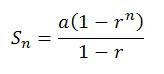
And rearranging, I immediately see that:


Now what is the sum to infinity then? Easy, it can be evaluated by considering the limit as n tends towards infinity:


Notice that this limit can only exist, if the common ratio r has a magnitude smaller than one, such that it decreases to effectively zero for huge values of n:


With this in mind, the sum to infinity is simply:


So applying this to the previous problem, we see that:


And therefore there is no actual need for any algebraic manipulation to solve for recurring numbers once you have grasped this theory. :)

Simple Algebra, or Not?

Well, I won't be doing much explaining in this post, so if you don't understand maybe I'll post another explanation for the second part; Luoning's tag has directed me to a very nice solution for determining fractional expressions for recurring decimals - it's a method taught to me by Mrs Pauline Kan way back in JC1, and I always turn to it for some mathematical fun when dealing with young Secondary School kids during tuition.

The question goes like this, given a recurring decimal like the one below, can you determine a fraction that equals it:


Well, the trick is to recognise that you can make use of the commutative properties of algebraic manipulation as follows:


And then by equating the two equations we must concur that:


And therefore:


But of course, for those budding Mathematicians out there, you may have seen this as a simple Geometric Progression sum to infinity, and therefore the general formula follows directly for such a sum:


I'm taking for granted that all of you know what Geometric Progressions are, haha.

Wednesday, August 6, 2008

For The Record

Well, here's just something Dr. Phil Chan, a really really really interesting Physics Professor, mentioned during my course in my first Semester at NUS:


Do you understand why? Haha. I probably won't be revealing this even if you don't get it, because Physicists truly are number one! :p

How Many Ways?


So, given this picture of four rooms interlinked by pink gates or doors, do you think you can find a route through the doors such that you pass through every door only once? Or do you think there's no such route?


----------------------------------


Well, Luoning nailed down the essence of my explanation; basically, it's got to do with the number of entrances to each room you see in the picture above. To facilitate the explanation, let me redraw the network of rooms above as such:


Notice I've represented each room by a black dot, which I shall now refer to as a node; so there's nodes A, B, C and D, each representing the rooms. Now, notice each node has lines connecting it to other nodes - these lines represent the doors or entrances leading from one room to another room.

Looking at this diagram, you'll find that it's much more easier to figure out possible routes.

So what did Luoning say again? Ah yes, the even or odd number of entrances! Indeed! Ask yourself what it means to be able to trace out a path where you don't re-use an entrance: this means that you must be able to arrive at the room the same number of times as you leave the room.

For you to arrive at the room the same number of times as you leave the room, one obvious condition is needed: you need each room to have an even number of entrances. Try it!

Of course, there is another condition: you could also have two rooms having an odd number of entrances but of course you need these rooms to be directly linked to one another as well. The direct linkage of these two rooms then means that the two rooms can be visualised as one big room and therefore reduces the number of effective entrances by one, turning an odd number of entrances into an even number of entrances!

Well I didn't think of this myself, but I did think of how to put forward this explanation myself! So give me some credit, won't ya? Haha.

So for this problem, of course no single route can be found! :)

[Edit: Hmm, this post isn't that well explained - I'll come back to this once I've figured out Graph Theory for myself!]