Showing posts with label Geometric Progression. Show all posts

Saturday, August 9, 2008

Sum To Infinity, and Beyond!

Well, what exactly is a Geometric Progression? To put it very simply, it is a sum or series that has the following pattern:


Of course, you may then ask what is the sum to infinite terms, or the sum to infinity for this series, and we can then represent it as such:


The previous post dealt with the problem of 0.11111… as a recurring decimal using the idea of a Geometric Progression, and I’m about to show you exactly how right now.

First of all, let us consider the sum to n terms (this is often called the partial sum of the first n terms):


It must then be agreeable and logical that if I multiply this by the common ratio r, I obtain:


Taking the difference of the two, I see that:


And rearranging, I immediately see that:
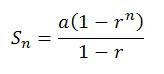

Now what is the sum to infinity then? Easy, it can be evaluated by considering the limit as n tends towards infinity:


Notice that this limit can only exist, if the common ratio r has a magnitude smaller than one, such that it decreases to effectively zero for huge values of n:


With this in mind, the sum to infinity is simply:


So applying this to the previous problem, we see that:


And therefore there is no actual need for any algebraic manipulation to solve for recurring numbers once you have grasped this theory. :)

Simple Algebra, or Not?

Well, I won't be doing much explaining in this post, so if you don't understand maybe I'll post another explanation for the second part; Luoning's tag has directed me to a very nice solution for determining fractional expressions for recurring decimals - it's a method taught to me by Mrs Pauline Kan way back in JC1, and I always turn to it for some mathematical fun when dealing with young Secondary School kids during tuition.

The question goes like this, given a recurring decimal like the one below, can you determine a fraction that equals it:


Well, the trick is to recognise that you can make use of the commutative properties of algebraic manipulation as follows:


And then by equating the two equations we must concur that:


And therefore:


But of course, for those budding Mathematicians out there, you may have seen this as a simple Geometric Progression sum to infinity, and therefore the general formula follows directly for such a sum:


I'm taking for granted that all of you know what Geometric Progressions are, haha.