Showing posts with label Relativity. Show all posts

Saturday, August 30, 2008

Newton's Legacy

Here’s something for you to think about – Newton’s Second Law is often quoted as the net external force on an object is the product of the object’s mass and its acceleration. Well I wouldn’t say that’s wrong, but that’s only truly correct in a classical sense. That is, the following equation only holds for non-relativistic speeds:


The more accurate way to quote Newton’s Second Law, which holds for all situations, is this: the net external force on an object is the time rate of change of momentum of the object itself. And we express this mathematically as:


And I’ll illustrate the generality of this expression by using this to derive a relativistic expression for the acceleration of a body. Now, to start off, let us recall the relativistic momentum expression:


And therefore the rate of change of momentum of a body must be given by a direct differentiation with respect to time:


And if you simplify this, it becomes:


And we recognize two things, that is:
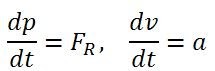

And therefore:


Notice that Newton’s Second Law no longer just involves the product of the mass and acceleration – this means that the expression F = ma is not a generally valid expression! And hence my conviction that Newton’s Second Law should be reformulated in terms of rate of momentum change instead.

Now, let us rearrange what we have above:


So let’s say you want to accelerate a body to the speed of light (c ms^-1), notice that as the speed v tends towards c, the acceleration tends to zero for a finite force:


So how do you accelerate something to a speed of c given that the acceleration fades away to zero when you near the speed of light? Easy, you use an infinite force! But is there such a thing as an infinite force? No! However, is there another way to go about it? Well, yes! Notice that as the mass goes towards zero:


Therefore, if the mass of a body is zero, then it is possible to accelerate the body all the way to the speed of light!

Ask yourself, what is the mass of a photon? :p It’s simply zero, which is expected! Otherwise it can’t go at the speed of light! :)

Wednesday, August 27, 2008

At The Speed of Light

It's now 8:00 am in the morning, and I just had this flash of inspiration whilst in the toilet; not too glamourous a situation for a brainwave, but oh well. Hopefully you all can understand what I'm about to type out.

Many years ago, Einstein as a young lad was thinking to himself: "What would happen or what would I see if I travelled at the speed of light? Would I see light waves or photons freeze in their tracks because I'm moving just as fast as them and thus the relative velocity between them and me is zero?"

And many years later, Einstein was convinced that no matter how fast one travels at, even at the speed of light, one will still see light travel at the speed of light.

Why?

Well, to first understand the situation, you must first understand the fundamental problem in Einstein's gedanken, that is, can you even see a stationary light wave?

The answer is a resounding and definite NO! Light, being composed of photons, are massless particles. From Einstein's mass energy equation, we therefore know that the total energy of a photon must be composed of its momentum-energy, that is, its kinetic energy, because it has no mass at all.

Now, to view a photon that is stationary, is then to view a photon without its kinetic energy - by denying a photon its kinetic energy, one essentialy annihillates that photon from sight. By travelling up to the speed of light, and to insist that one can still see light, then the light waves that one sees while travelling at the speed of light, must still be moving, and can't be at zero velocity.

You all got that? Haha.

And I guess I'll stop here for a while - I'll come back to explain further (in another post) why you need to be massless to move at the speed of light. :)

Friday, January 25, 2008

Particulate This!

Everyone's heard of Feynman Diagrams (or maybe not! :p) but what exactly are these? To begin understanding such a pictorial diagram of quantum processes, one first needs an example, which is aptly shown below:
I haven't quite drawn the diagram in the conventional way (without the axes being labelled) because I want the meaning of the diagram to be explicit. In this diagram, the bottom left arrow depicts an electron moving to the right - notice that it moves upwards (in time) meaning it is travelling forward in time, and it moves right (in position) meaning it is travelling to the right in real life.

The bottom right arrow represents a positron (the anti-electron) - in this convention, all anti-particles are drawn with a reversed arrow, so while the electron has an arrow that points forward in time, the positron has an arrow that points backwards in time. You might ask: why so? Simply put, an antiparticle is a particle travelling forward in time! We'll have more on that later; for the time being, suffice it to say that this is the convention we're going to adopt.

You'll notice two dotted lines at the top, which corresponds to two identical photons - you might notice that there are no arrows at all. Want to fashion a guess? It's because a photon is its own anti-particle, and hence no arrow is needed to distinguish between a photon and an anti-photon at all. Hey wait a minute! Are you saying that photons can actually be travelling forward and backwards in time? Perhaps, for light itself defines the very limits of time travel, and maybe only a photon can experience true time travel without being altered itself.

So how do I read this diagram? Easy, if we use the conventional wisdom of our real world, we say that an electron and a positron travel towards one another, collide, annihilate, and their mass energy is converted into electromagnetic radiation in the form of two photons that travel away from one another.

But in modern Physics, there is an alternative viewpoint: an electron moves from the left to the right, and at one moment in time, emits two photons. The emitting of these two photons causes the electron to change its momentum in time, and causes it to move backwards in time, becoming a positron that goes on towards the right, but backwards in time.

Well, that's all for this post - till when I'm feeling awake again!