Showing posts with label Mathematics. Show all posts

Monday, July 21, 2008

Complex Power

Well, here's something I asked one of my students, Cassandra, and let's see how many people actually manage to figure it out by, say, the end of the week:


Have a go at it!

----------------------------------------

Some of you might be thinking this problem might be adequately solved if one considers Euler’s exponential form of complex numbers:


But here’s another problem; we know that:


In fact, the number i is obtained each time we make a full revolution in the imaginary phase space, such that:


Does that mean now that:


Go figure!

------------------------

Well, the answer actually is very simple: you just have to define the allowed values of the argument that define the imaginary number i, such that it can be placed to the power of something. :)

Oh yeah, this answer was contributed by Kenneth Tay Jingyi!

Wednesday, July 16, 2008

2nd Round


This is the second question of the 1st IPhO - try it for kicks! (Click on it to view the enlarged picture - same for all other pictures in this post!)

--------------------------------------

I actually remember doing this in Physics ‘S’ paper! Haha. So let’s give it a try, using my well, noob method. Let’s consider a simple system at the start first:


Obviously the resistance here is just the simple sum of two resistors in series:


Let’s continue to add two more resistors; notice that I’ve renamed one of the resistors x (you’ll know why in a second!):
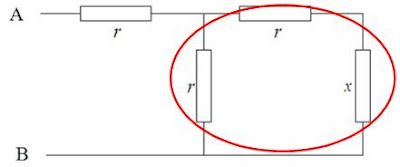


This is a little trickier; the resistance here must take into account the parallel circuitry, which I’ve circled out in red. If you can’t see this, well, let me redraw it in a more accessible manner:


And of course, if you still remember the formula for parallel resistors, this new set-up has a fairly easy to calculate expression for its resistance:


And then let’s do one more addition of a branch to see how everything adds up, to understand how I’m going to simplify the situation:


Well, without redrawing it, I’d expect you to say that the set-up now consists of two parallel set-ups. For those who can’t see yet, I’ve tried to point out using circles again. Look above at the blue circle; I can represent this as a resistor x, and then the diagram is simplified into:


And what do you notice? Haha, we’ve already obtained the resistance for this, which was determined earlier to be:


So what’s x? Well, let’s find out; referring to the blue circle, I see that x’s resistance is simply equivalent to a set of parallel resistors:


Okay, so that you’ve roughly got my trick of simplifying, let’s do a long set so that you’ll be seeing what I’m seeing:

Let’s do the red circle first, and let’s call this new resistor a:


Now, treating the red circle as a resistor a, we can simplify the diagram into:


Alright, so now let’s do the blue circle and let’s call this new resistor b:


So now we can simplify again:


And now let’s do the green circle and let’s call this resistor c:


And now, let’s simplify again:


This couldn’t be simpler, and let’s do the orange circle this time and call it a resistor d, and find its resistance:


With this, we can then simplify our diagram as:


And the overall resistance is therefore simply:


Now, if you haven’t seen or noticed the pattern yet, let me just write out everything in full:


What a monster! You may want to view it in full size, haha. Notice that there is a repeating unit! And if the series goes on and on indefinitely, let me just re-write it in a more digestible way:


Can you spot the repeating unit yet? Haha. If you haven’t spotted the recurring unit yet, it’s simply this monster right here:


But what is this creature? Notice that the overall resistance R is just the repeating unit:


So how do we solve this thing? Well, algebra gives us a good method:


And then now we manipulate this expression into a quadratic equation, as such, to obtain R:


Which can then be solved using the standard quadratic equation (notice I’ve rejected the negative answer since no resistance is negative):


And as some of you might have already noticed, the Golden Ratio (phi) appears in the answer:


Such that:

Well, what is the Golden Ratio? Let’s leave that for another entry, because I’m absolutely tired of typing out equations and expressions for the day. I’ll give a hint though; recall the Fibonacci sequence as:


If you look closely, each succeeding term is obtained via addition of its two preceding terms. Well, if you take any term and divide it by its preceding term, you’ll obtain a number close to the Golden Ratio (phi). Let’s say we take 89 and 55:


And this ratio gets increasingly closer to the Golden Ratio as one continues on into the series.

And wow! What a lengthy post! And it's rather strange isn't it? Then adding more and more resistors forces your resistance into a fixed, finite value instead of an infinite resistance, and the fact that the Golden Ratio pops up in such an instance! Simply amazing! :p

Monday, July 14, 2008

Another Youtube Conundrum

Here’s another interesting video of a false proof I found on Youtube, which shows a rather interesting argument of why 1 = 2. See if you can spot the mistake (the mistake comes in rather early!):


I'll probably post the answer when I get home from work later, so you can have a go at it while there's time. Heh.

------------------------------------------
Well, the answer is easy: you can never divide by zero, because to divide by zero really means multiplying both sides of the equation by infinity, and everyone knows that infinity isn’t a number, it’s just an indication of the tendency of a number towards huge value.

For instance, look at the following treatment:

2 > 1

Hence: 2(∞) > ∞

Does it makes sense? Well, of course not! There’s no such thing as something that is twice as infinite as another! Infinity isn’t a number, but just a limit.

Harkening back to the question, notice that we allowed b = a, which means that (b – a) = 0. And thus this step is wrong:


Reminds me that grace is God’s way of loving us infinitely as much as an infinite God can already possibly love.


Youtube Conundrum

Well well, look what I found on Youtube:


It's a false proof by the way: can you spot the mistake? :p

----------------------------------------------------------------

If you haven't figured it out, here's the explanation. The mistake lies in the very first line, where we have:


Now it makes sense that the right hand side involves a square root of (-1) squared - now a square root of something that is squared, immediately yields back itself, as such:


And so:


So how can you even write this first line down? It is a fallacy and not even an identity to start with! In fact, this is one of the problems Secondary School kids and JC kids struggle with. Do you know that what goes into the square root sign is important?

If you don't know what goes into the square root sign, then we can say both positive and negative answers are ok; but if you know that what goes inside is positive for sure, or negative for sure, then obviously the answer must be positive, or negative, and not both! I've shown this below for you to see:


So now, can we say that this is true:


Of course not! The left hand side has (-1) as its ingredients, and it is made explicit, and the right hand side has (1) as its ingredient, and it is made explicit as well. So how can you say that they're equal!

Don't get conned kids! :p

How Mean Are They?

Recall that in an earlier post, I pointed out that there were four different kinds of means that commonly pop up in physical situations, and to recap your memory, they are:


The Arithmetic Mean

The Geometric Mean

The Harmonic Mean

The Power Mean

Oh and before anything, I shall just assume both numbers are positive, so it simplifies my working. :)

And of course, I’ll now endeavour to show the relative magnitudes of the above means I’ve stated, and I’ll start with the power mean (I’ll consider a specific one, the quadratic mean) and geometric mean first, since these two are easiest to compare:


Another easy pair is the arithmetic mean and the geometric mean:


The next easy pair should then be the arithmetic mean and the quadratic power mean:


Notice that I’ve used the same inequality over and over again, namely:


Is that amazing, or what? Let’s now recap:


So this leaves us with the harmonic mean, which can be a rather nasty affair, but with some tricks again, we’ll see:


There you have it: by proving that the geometric mean is greater than the harmonic mean, we no longer have to prove the other pairs of means, because the geometric mean was the least in our previous analysis. And therefore, we can now say:


So why have I determined the order of the magnitudes of the different means? Well, it's to show you that there is no such thing as "one mean is more mean than the other"; their magnitudes can still differ considerably from one another! Therefore, we can't really say one mean is better than the other, but rather, we have to look at the situation, and what the situation calls for, before we choose the appropriate mean to use.

Another conclusion can be drawn if you look at their mathematical structure: if you look at the geometric mean, one may think it's not giving equal weightage to both numbers; but what if you think about the powers? Multiplying two numbers together means you're adding their powers together, and taking the square root halves their powers added, and thus the geometric mean effectively gives you the mean of the powers of the two numbers.

How about the harmonic mean? It's interesting, because the product of the two numbers is weighed by the sum of the two numbers - it is as if this mean weighs the two numbers according to how big they are, or how small they are! I'll speak more on this in a later post.

And all of these things are nice to chew upon. Heh. :)